Sign language access is often framed as an individual disability accommodation. That framing is incomplete. When communication barriers systematically limit access to healthcare, emergency information, education, and public messaging for Deaf and hard of hearing populations, the issue moves beyond accommodation and into public health.
Public health is concerned with population level outcomes, preventable harm, health equity, and systemic risk. Communication access directly affects all four.
This article examines sign language access through a public health lens, analyzes research on Deaf health disparities and language deprivation, and outlines how interpreters and CART captioning services function as critical public health infrastructure.
Public Health Framing: Why Communication Access Is Systemic
Public health focuses on structural conditions that shape health outcomes across populations. According to the World Health Organization and U.S. Centers for Disease Control and Prevention, social determinants of health include education access, health literacy, economic stability, and social inclusion.
Language access intersects with each of these determinants.
When Deaf individuals cannot access health information in a fully accessible language, the result is not simply inconvenience. It is measurable disparity.
Research published in The Lancet Commission on Global Hearing Loss and studies in journals such as Disability and Health Journal demonstrate that communication barriers are associated with:
- Lower preventive care utilization
- Reduced cancer screening rates
- Increased emergency department use
- Poorer chronic disease management
- Higher rates of mental health distress
These are population level outcomes. That is the definition of a public health issue.
Language Deprivation and Long Term Health Impact
Language access begins in early childhood. Research on critical periods of language acquisition, including work by Mayberry and colleagues, shows that delayed language exposure can lead to long term cognitive and educational consequences.
Language deprivation is not simply a linguistic issue. It has cascading health implications:
- Reduced health literacy
- Limited comprehension of medical terminology
- Lower trust in healthcare providers
- Higher vulnerability to misinformation
A 2016 study in Preventive Medicine found that Deaf adults with limited early language access demonstrated significantly lower health literacy compared to hearing peers. Health literacy is strongly associated with hospitalization rates, medication adherence, and preventive screening compliance.
When sign language access is delayed or denied in childhood, the public health impact extends across decades.
Deaf Health Disparities and Structural Communication Barriers
Deaf health disparities are well documented in peer reviewed literature. Studies from McKee et al., Barnett et al., and Kushalnagar et al. consistently show disparities in cardiovascular risk awareness, cancer knowledge, and mental health outcomes.
The question is not whether disparities exist. The question is why.
Several structural factors contribute:
1. Inaccessible Clinical Encounters
Relying on lip reading, written notes, or automated captions in complex medical discussions increases risk of misunderstanding. Research in Journal of General Internal Medicine has shown that absence of qualified interpreters is associated with higher rates of medical error and lower patient satisfaction.
Automated captions, while improving, are not consistently accurate in specialized terminology, accented speech, or rapid exchanges. In high stakes clinical contexts, small inaccuracies can materially affect informed consent and treatment adherence.
2. Inaccessible Public Health Messaging
During public health emergencies, press briefings are often delivered with delayed interpretation, small interpreter windows, or poor camera framing. Caption quality varies significantly.
Studies examining communication during the COVID 19 pandemic documented inconsistent interpreter visibility and caption errors in televised briefings. Public health messaging that fails to reach Deaf populations equally creates information asymmetry.
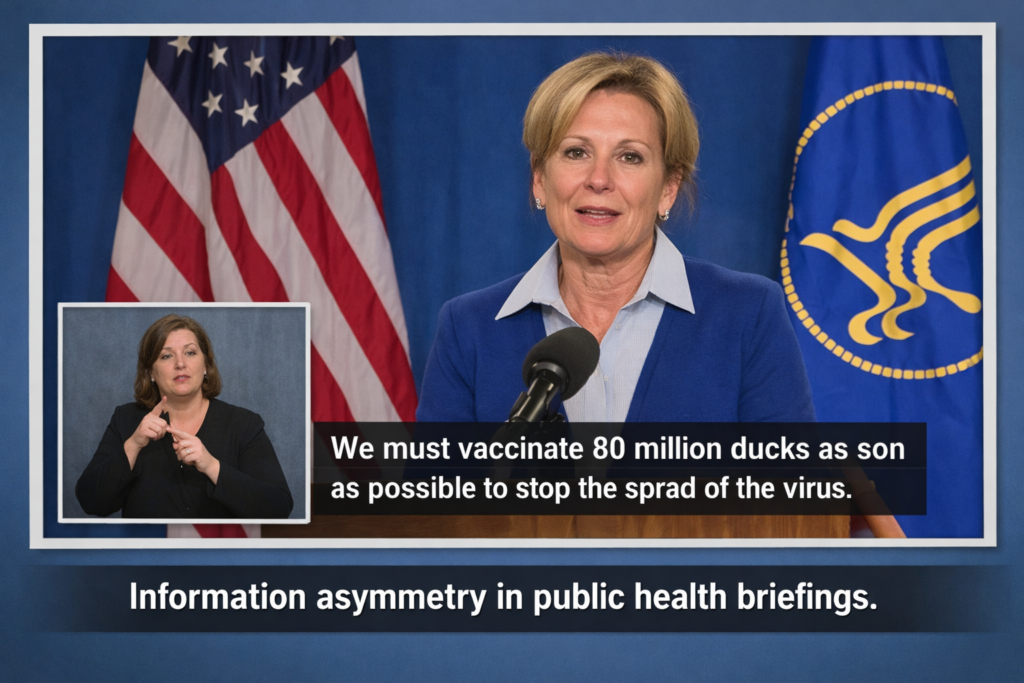
Information asymmetry increases risk exposure.
3. Educational Barriers
Education is a core social determinant of health. When educational systems fail to provide early sign language access or qualified CART captioning services, long term literacy and employment outcomes are affected. These, in turn, correlate with health outcomes.
Public health does not operate in isolation from education policy.
Legal and Compliance Framework
Sign language access is also a legal obligation.
In the United States:
- The Americans with Disabilities Act requires effective communication in healthcare and public services.
- Section 504 of the Rehabilitation Act mandates equal access in federally funded programs.
- The Affordable Care Act Section 1557 reinforces nondiscrimination in healthcare settings.
In Canada:
- The Accessible Canada Act and provincial legislation such as AODA impose accessibility standards.
- Human rights codes require accommodation to the point of undue hardship.
Regulatory guidance consistently emphasizes effective communication, not merely minimal access.
Courts have ruled that failure to provide qualified interpreters in healthcare settings can constitute discrimination. Settlements involving hospitals have included mandatory policy reforms and financial penalties.
From a compliance perspective, institutions that treat sign language access as optional expose themselves to liability risk.
Professional Interpreters and CART Captioning as Public Health Infrastructure
Public health infrastructure includes systems that enable equitable access to information. Clean water systems, vaccination programs, and emergency alert networks are examples.
Communication access should be categorized similarly.
Qualified Sign Language Interpreters
Professional interpreters provide linguistically and culturally competent access in clinical, educational, and emergency contexts. Research shows improved comprehension and patient satisfaction when qualified interpreters are present compared to ad hoc solutions.
CART Captioning Services
CART captioning services provide real time transcription with high accuracy and contextual awareness. In medical lectures, university classrooms, public meetings, and internal institutional communications, CART reduces reliance on automated systems that may introduce error.
For hard of hearing individuals who prefer English text access, CART can be more appropriate than interpretation alone.
When integrated systematically rather than reactively, these services function as prevention tools. They reduce downstream risk associated with miscommunication.
Integrating Sign Language Access into Public Health Planning
Institutions that treat communication access as an operational afterthought typically respond case by case. A public health model requires proactive integration.
1. Embed Language Access into Emergency Preparedness
- Ensure interpreter visibility in all public briefings.
- Integrate CART feeds into live streaming infrastructure.
- Audit caption accuracy across platforms.
2. Standardize Healthcare Communication Protocols
- Develop interpreter scheduling systems embedded in electronic health workflows.
- Avoid sole reliance on automated captions for clinical consent processes.
- Conduct periodic communication access audits.
3. Incorporate Accessibility into Health Literacy Campaigns
- Produce sign language video materials alongside written materials.
- Provide real time captioning at public health town halls and vaccine clinics.
- Evaluate comprehension outcomes among Deaf participants.
4. Fund Communication Access as Institutional Responsibility
Shifting costs to individual patients or students creates inequity and undermines compliance obligations. Public health systems fund infection control centrally. Communication equity should follow the same logic.
Reframing the Policy Conversation
Treating sign language access solely as an accommodation narrows responsibility to individual requests. Treating it as a public health imperative broadens responsibility to system design.
Public health prioritizes prevention, equity, and measurable outcomes. Communication barriers create preventable harm and measurable disparity. The alignment is clear.
The remaining issue is institutional will and infrastructure investment.
FAQ: Sign Language Access and Public Health
Why is sign language access considered a public health issue?
Because communication barriers affect health literacy, preventive care use, emergency information access, and long term health outcomes across a population, not just individuals.
How does language access in healthcare reduce disparities?
Qualified interpreters and CART captioning services improve comprehension, informed consent accuracy, treatment adherence, and patient satisfaction, reducing preventable complications.
Are automated captions sufficient for medical settings?
Automated captions can assist but are not consistently accurate enough for high stakes medical communication. Regulatory guidance emphasizes effective communication, which often requires professional services.
What laws require sign language access?
In the U.S., ADA and Section 504 require effective communication in healthcare and public services. In Canada, federal and provincial accessibility laws impose similar obligations.
Conclusion
Sign language access intersects with education, emergency preparedness, healthcare delivery, and legal compliance. The evidence linking communication barriers to health disparities is substantial.
Institutions that approach sign language access as public health infrastructure rather than discretionary accommodation are better positioned to reduce liability, improve outcomes, and advance communication equity.