Institutions frequently approach accessibility planning with a simplified assumption: Deaf and hard of hearing individuals require the same type of accommodation. Research and lived experience demonstrate otherwise. Communication preferences among hard of hearing individuals vary significantly based on linguistic background, age of hearing loss onset, educational history, cognitive processing patterns, and cultural identity.
Understanding the distinction between CART captioning services and ASL interpretation services is essential for university accessibility departments, HR leaders, healthcare administrators, and compliance officers. Providing appropriate accessibility accommodations requires evidence based assessment rather than assumption.
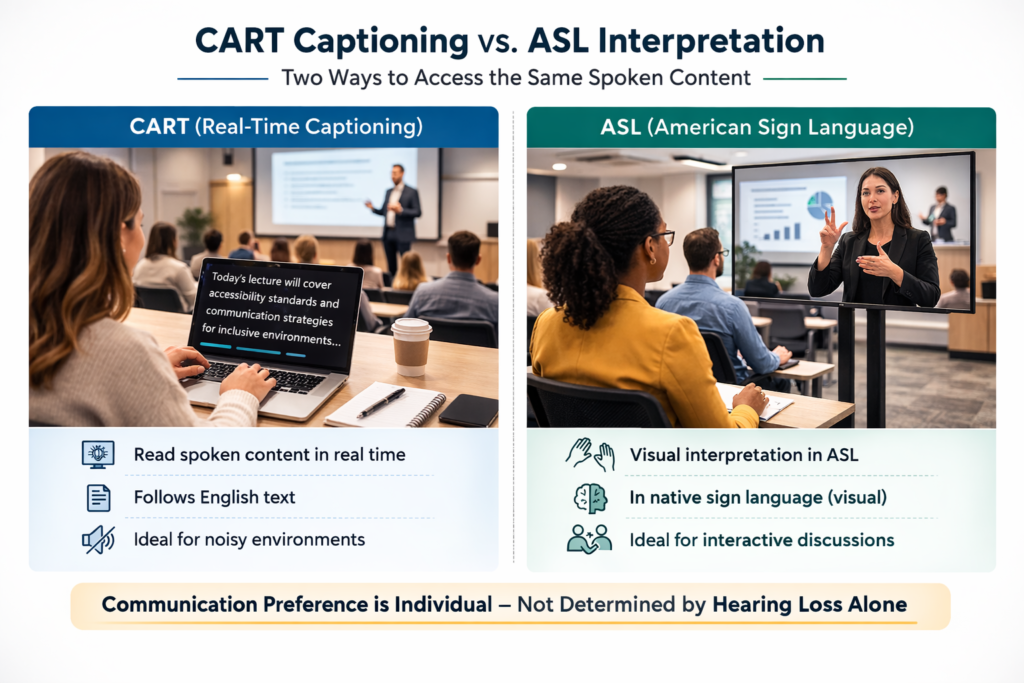
CART vs ASL: Distinct Communication Modalities
CART, or Communication Access Realtime Translation, provides real time captioning of spoken content into written English. It supports individuals who rely on visual text to access auditory information.
American Sign Language is a distinct natural language with its own grammar and syntax, separate from English. ASL interpretation services provide translation between spoken English and ASL.
Linguistically, these modalities are not interchangeable. ASL is not “signed English.” Research in linguistics confirms that ASL has its own structure and is not a manual representation of English word order (Sandler & Lillo Martin, 2006). CART, by contrast, preserves spoken English in written form.
For individuals whose primary language is English, real time captioning may align more closely with their linguistic foundation. For individuals whose primary language is ASL, interpretation may provide more natural comprehension.
Age of Hearing Loss Onset and Language Acquisition
One of the strongest predictors of communication preference is age of hearing loss onset.
Research on critical periods of language acquisition shows that early accessible language exposure is essential for typical cognitive and linguistic development (Mayberry, 2007). Individuals born Deaf to signing families often acquire ASL as a first language. For them, ASL interpretation services may offer more direct linguistic access than English text.
In contrast, late deafened adults typically acquire spoken and written English in childhood before experiencing hearing loss. Studies show that late deafened adults often retain strong literacy in English and may prefer CART captioning services because it reflects their primary language system (Napier et al., 2018).
From a cognitive perspective, comprehension is generally more efficient when delivered in one’s dominant language. Therefore, CART vs ASL preference frequently aligns with first language exposure rather than severity of hearing loss.
Literacy, Education, and English Proficiency
Literacy outcomes among Deaf and hard of hearing individuals vary widely due to differences in early language access and educational placement.
Research has documented persistent variability in English literacy among Deaf individuals, particularly those who experienced language deprivation in early childhood (Hall et al., 2017). For individuals whose English literacy is limited due to delayed exposure, real time captioning may not provide optimal comprehension. ASL interpretation may better support conceptual access.
Conversely, many hard of hearing individuals educated in mainstream settings develop strong English reading proficiency. For these individuals, CART captioning services may provide immediate, precise access to complex terminology in higher education, medical environments, or corporate meetings.
This distinction is particularly relevant in university settings, where academic language density is high. Research suggests that real time captioning improves lecture comprehension and note taking for students who rely on English text (Marschark et al., 2009).
Preference is therefore often linked to educational history and literacy development rather than degree of hearing loss.
Residual Hearing and Auditory Processing
Hard of hearing individuals often have residual hearing and may use hearing aids or cochlear implants. Their communication access needs differ from individuals with profound Deafness.
Studies on speech perception variability indicate that even with amplification, speech recognition accuracy fluctuates depending on background noise, speaker clarity, and fatigue (McCreery et al., 2017). Real time captioning provides visual reinforcement that reduces cognitive load in noisy or fast paced environments.
For some individuals, CART captioning services supplement residual hearing effectively. For others, particularly those who rely primarily on visual language, ASL interpretation services provide clearer comprehension than partially audible speech supported by text.
Environmental context also matters. In medical or legal settings where accuracy is critical, some individuals prefer CART because it provides a verbatim record. In community or social environments, ASL may feel more natural and conversational.
Bilingual Bimodal Development and Cultural Identity
Some Deaf and hard of hearing individuals are bilingual in ASL and English. Research on bilingual bimodal development demonstrates that exposure to both a signed and spoken language can support cognitive flexibility and metalinguistic awareness (Petitto et al., 2001).
For bilingual individuals, communication preference may shift depending on context. In academic lectures heavy in English terminology, CART may be preferred. In interactive discussions, ASL interpretation services may feel more fluid.
Cultural identity also influences choice. Individuals who identify strongly with Deaf culture may prefer ASL as an expression of linguistic and cultural affiliation. Others who identify as hard of hearing rather than culturally Deaf may prefer text based communication access.
Assuming that all hard of hearing individuals use ASL overlooks demographic data. In North America, the majority of hard of hearing adults do not use ASL as their primary language (Mitchell et al., 2006). Institutional planning that defaults to interpretation without assessment risks misalignment.
Cognitive Load and Information Density
Cognitive processing research suggests that comprehension efficiency declines when individuals must divide attention across multiple inputs. For some hard of hearing individuals, reading captions while watching slides is manageable. For others, shifting visual focus between caption feed, speaker, and presentation materials increases fatigue.
ASL interpretation requires visual attention to the interpreter. In large lectures or hybrid meetings, this may require screen pinning or strategic seating placement.
There is no universally superior modality. The optimal accommodation depends on individual processing strengths and environmental design.
Common Misconceptions
Several misconceptions persist in accessibility planning:
- All hard of hearing individuals use ASL.
- CART captioning is only for individuals who do not sign.
- Degree of hearing loss determines accommodation type.
Peer reviewed research does not support these assumptions. Communication access preference is shaped by linguistic history, education, and identity rather than audiogram alone.
Compliance frameworks such as the ADA and Section 504 emphasize individualized assessment rather than categorical assignment of services. Institutions that substitute one modality without consultation risk both reduced comprehension and legal exposure.
Practical Guidance for Institutions
For universities, employers, healthcare providers, and event planners, the most effective approach to accessibility accommodations includes:
1. Individualized Assessment
Ask the individual directly which accommodation supports optimal comprehension. Avoid substituting services without consent.
2. Provide Modality Options
Where feasible, maintain contracts for both CART captioning services and ASL interpretation services. Complex events may require both.
3. Consider Context
Academic lectures, medical consultations, performance reviews, and conferences differ in linguistic complexity and interaction style. Preferences may vary across settings.
4. Avoid Cost Based Substitution
Replacing professional services with automated captions without consultation undermines communication access and may violate disability compliance standards.
5. Document Interactive Process
Maintain records demonstrating good faith effort to provide effective communication, as required under accessibility legislation.
Conclusion
Hard of hearing communication preferences are not uniform. CART vs ASL decisions reflect linguistic development, age of onset, literacy, residual hearing, cognitive processing patterns, and cultural identity.
Evidence from linguistics, cognitive science, and deaf education research consistently shows that effective communication access depends on alignment with the individual’s primary language and processing strengths. Institutions that approach accessibility accommodations with nuance rather than assumption are more likely to achieve compliance, equity, and meaningful inclusion.
Neither CART captioning services nor ASL interpretation services are inherently superior. Each serves distinct populations and contexts. The determining factor is not severity of hearing loss, but communication history.
Suggested Visual Concept
Title: Factors Influencing Communication Preference
Concept:
A clean infographic listing five influencing factors in separate boxes:
• Age of hearing loss onset
• Primary language exposure
• Literacy background
• Residual hearing
• Cultural identity
Below the boxes:
“Communication access should be individualized, not assumed.”
Caption:
Multiple linguistic and developmental factors influence whether a hard of hearing individual prefers CART captioning or ASL interpretation.
Alternative Text:
Infographic listing factors influencing hard of hearing communication preferences, including age of onset, primary language, literacy, residual hearing, and cultural identity.
References
Hall, W. C., Levin, L. L., & Anderson, M. L. (2017). Language deprivation syndrome. Maternal and Child Health Journal, 21(3), 607–616.
Marschark, M., Sapere, P., Convertino, C., & Pelz, J. (2009). Learning via direct and mediated instruction by Deaf students. Journal of Deaf Studies and Deaf Education, 14(4), 546–561.
Mayberry, R. I. (2007). When timing is everything: Age of first language acquisition effects on second language learning. Applied Psycholinguistics, 28(3), 537–549.
McCreery, R. W., et al. (2017). Speech recognition variability in listeners with hearing loss. Ear and Hearing, 38(4), 433–444.
Mitchell, R. E., Young, T. A., Bachleda, B., & Karchmer, M. A. (2006). How many people use ASL in the United States? Sign Language Studies, 6(3), 306–335.
Napier, J., McKee, R., & Goswell, D. (2018). Sign Language Interpreting: Theory and Practice. Palgrave Macmillan.
Petitto, L. A., et al. (2001). Bilingual signed and spoken language acquisition from birth. Science, 293(5530), 1815–1818.
Sandler, W., & Lillo Martin, D. (2006). Sign Language and Linguistic Universals. Cambridge University Press.