Hearing technology has advanced significantly over the past several decades. Today, individuals with hearing loss often face an important question when exploring treatment options: Should I use a hearing aid or consider a cochlear implant?
The correct answer depends largely on the type, severity, and biological cause of hearing loss. Hearing aids and cochlear implants address different physiological problems in the auditory system, and they are designed for different clinical situations.
Understanding how hearing works and how these technologies function helps patients, clinicians, accessibility coordinators, and families make informed decisions about hearing technology options and communication accessibility solutions.
Overview of Hearing Loss
How Hearing Works in the Ear
Human hearing involves several interconnected structures within the auditory system:
Outer ear:
The outer ear collects sound waves and directs them into the ear canal.
Middle ear:
Sound vibrations strike the eardrum and move through three small bones called the ossicles (malleus, incus, and stapes).
Inner ear (cochlea):
The cochlea contains microscopic hair cells that convert mechanical sound vibrations into electrical signals.
Auditory nerve:
These electrical signals travel along the auditory nerve to the brain, where they are interpreted as sound.
Damage anywhere along this pathway can produce hearing loss.
Common Types of Hearing Loss
Conductive Hearing Loss
Conductive hearing loss occurs when sound cannot efficiently travel through the outer or middle ear.
Common causes include:
- ear infections
- fluid in the middle ear
- earwax blockage
- damage to the ossicles
Conductive hearing loss is often treatable with medical or surgical intervention, though hearing aids may also be used.
Sensorineural Hearing Loss
Sensorineural hearing loss is the most common form of permanent hearing loss. It occurs when hair cells inside the cochlea are damaged.
Common causes include:
- aging (presbycusis)
- prolonged noise exposure
- genetic factors
- certain medications
- viral infections
Because damaged hair cells cannot regenerate in humans, treatment focuses on hearing technology such as hearing aids or cochlear implants.
Mixed Hearing Loss
Mixed hearing loss involves both conductive and sensorineural components. Treatment depends on which structures are affected.
Clinical evaluation by an audiologist is essential because treatment options depend on the specific biological cause of hearing impairment.
What Is a Hearing Aid?
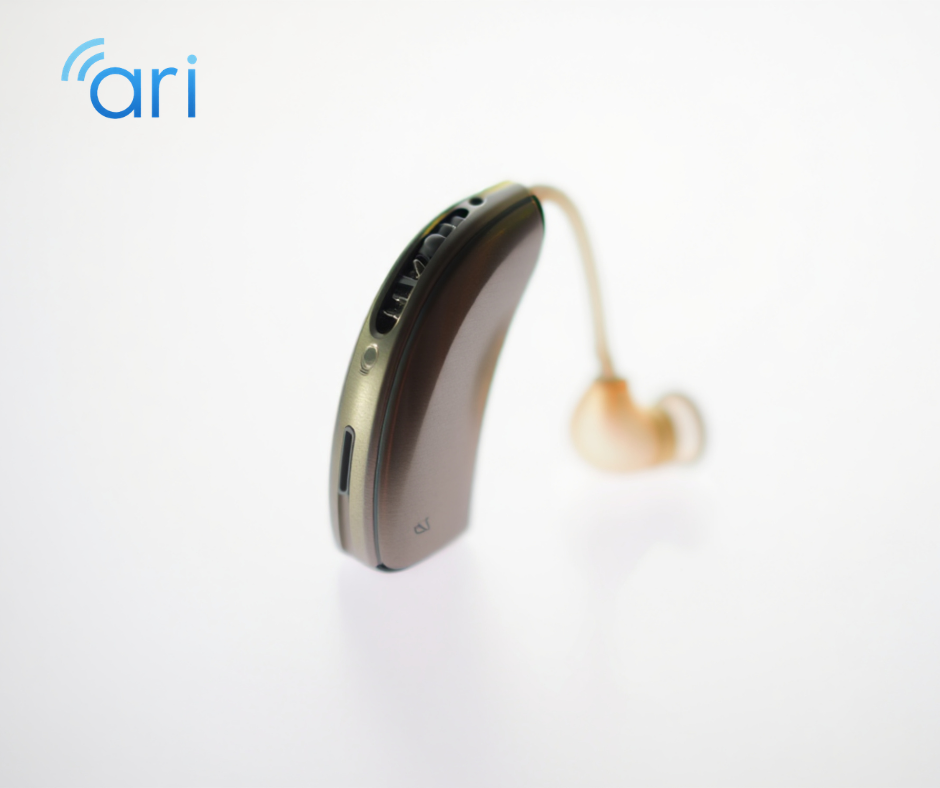
A hearing aid is an electronic device designed to amplify sound so that the ear can continue using its natural hearing pathway.
How Hearing Aids Work
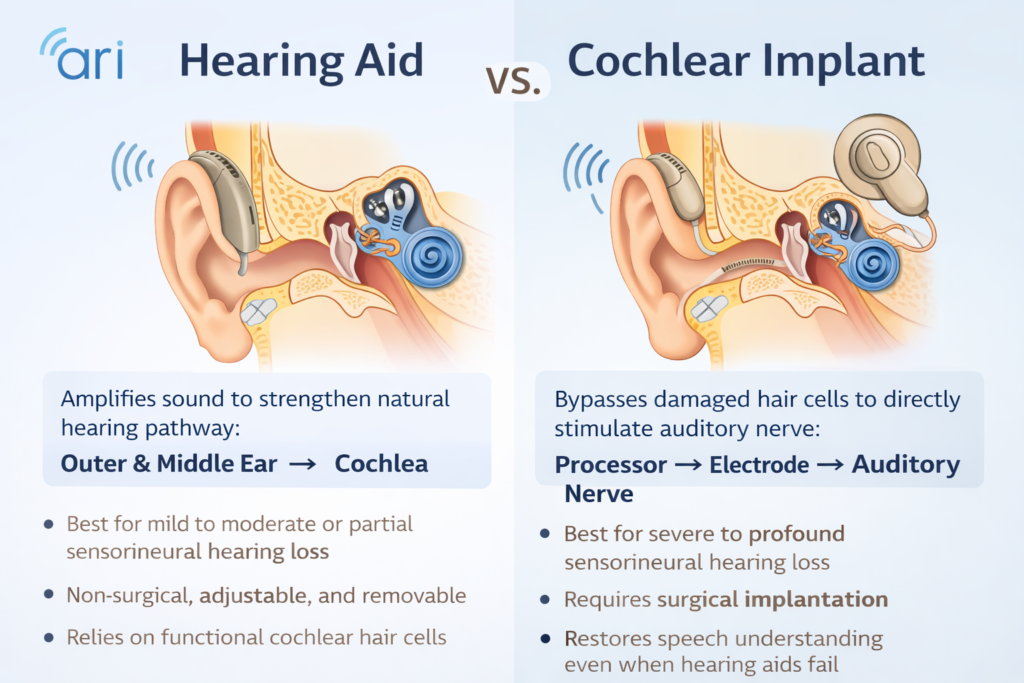
The basic signal pathway of a hearing aid is:
Sound → microphone → digital amplification → speaker → ear canal → cochlea processes the signal
Modern digital hearing aids also include advanced signal processing features such as:
- noise reduction algorithms
- directional microphones
- wireless connectivity with phones and computers
These technologies improve listening clarity in complex environments.
When Hearing Aids Are Typically Recommended
Hearing aids are generally the first treatment for many types of hearing loss.
They are typically recommended for:
- mild hearing loss
- moderate hearing loss
- many cases of moderate to severe hearing loss
- individuals whose cochlear hair cells still retain some functional capacity
Research published in the Journal of the American Academy of Audiology and Ear and Hearing demonstrates that amplification can significantly improve speech perception when hair cell damage is partial rather than complete.
Advantages of Hearing Aids
Hearing aids offer several benefits:
- non surgical treatment
- lower cost compared with cochlear implants
- preserves natural acoustic hearing
- adjustable settings based on listening environment
- removable and customizable devices
For many individuals, hearing aids provide sufficient improvement in communication ability.
Limitations of Hearing Aids
Hearing aids rely on the cochlea's ability to process sound.
If cochlear hair cells are severely damaged, amplification may not solve the problem.
Common limitations include:
- amplification cannot repair destroyed hair cells
- speech clarity may remain poor in advanced sensorineural hearing loss
- background noise may still interfere with speech perception
When hearing aids no longer provide meaningful benefit, clinicians may evaluate whether cochlear implants for hearing loss could be more effective.
What Is a Cochlear Implant?
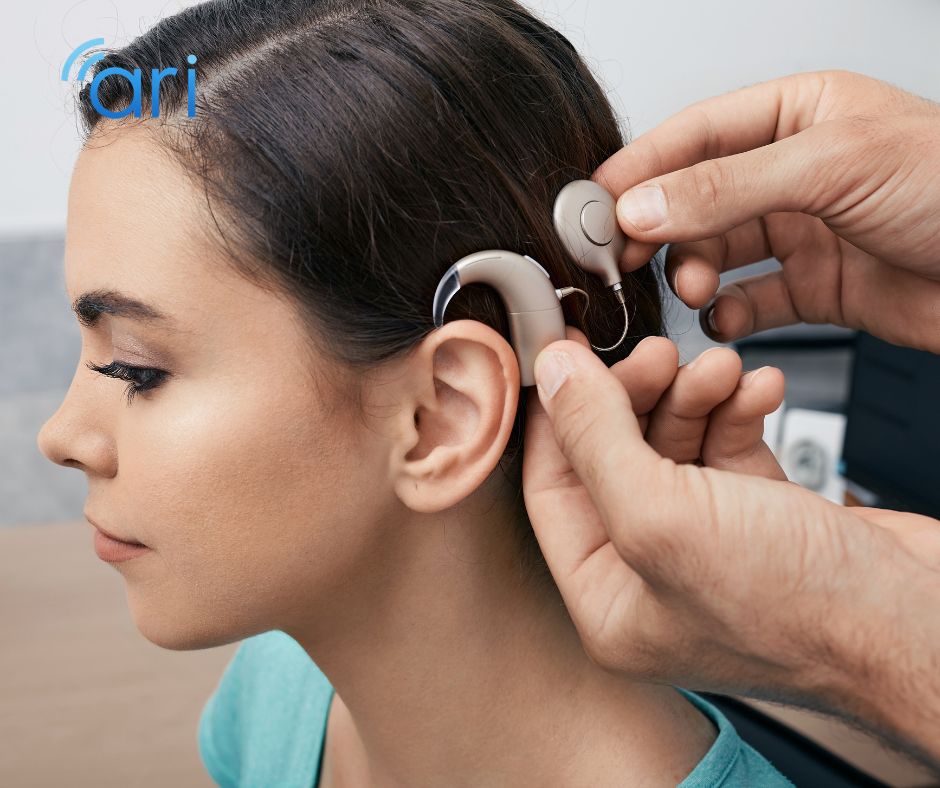
A cochlear implant is a medical device designed to bypass damaged hair cells in the cochlea and directly stimulate the auditory nerve with electrical signals.
Unlike hearing aids, cochlear implants do not rely on acoustic amplification.
How Cochlear Implants Work
The signal pathway of a cochlear implant is:
Sound → external processor → digital signal processing → electrode array implanted in cochlea → auditory nerve stimulation → brain interprets sound
The system has two main components:
External processor
- worn behind the ear
- captures sound and converts it into digital signals
Internal implant
- surgically placed in the inner ear
- contains an electrode array that stimulates the auditory nerve
The brain then learns to interpret these signals as sound.
When Cochlear Implants Are Recommended
Cochlear implants are typically recommended for:
- severe sensorineural hearing loss
- profound hearing loss
- individuals who receive minimal benefit from hearing aids
Clinical studies published in Otology and Neurotology, Lancet Neurology, and the New England Journal of Medicine have demonstrated that cochlear implants can significantly improve speech perception in individuals who cannot benefit from conventional amplification.
The National Institute on Deafness and Other Communication Disorders (NIDCD) also recognizes cochlear implants as a major treatment for profound hearing loss.
Advantages of Cochlear Implants
Cochlear implants can provide several important benefits:
- improved speech perception in severe hearing loss
- functional hearing in individuals with profound deafness
- improved language development when implanted early in children
- better communication ability in many cases where hearing aids fail
These outcomes have been documented in multiple long term clinical studies.
Limitations of Cochlear Implants
Despite their benefits, cochlear implants also have limitations.
Considerations include:
- surgical implantation is required
- sound perception differs from natural acoustic hearing
- extensive auditory rehabilitation may be needed
- the brain must adapt to electrical stimulation signals
Some individuals require months of therapy and listening practice to maximize benefit.
How Doctors Decide Between a Hearing Aid and Cochlear Implant
Audiologists and otolaryngologists follow structured evaluation procedures when recommending hearing technology.
Typical Clinical Evaluation Process
- Comprehensive hearing test
Pure tone audiometry and speech recognition testing measure hearing thresholds and speech clarity. - Hearing aid trial
Patients are typically fitted with hearing aids first to determine whether amplification provides adequate benefit. - Speech recognition evaluation
Clinicians measure how well patients understand speech while wearing hearing aids.
If speech recognition scores remain poor, cochlear implant evaluation may be recommended.
Common Clinical Guideline
Many clinical protocols use speech recognition thresholds as a decision point.
If a patient achieves speech understanding scores below roughly 40 to 50 percent with well fitted hearing aids, a cochlear implant evaluation may be appropriate.
These guidelines are supported by research from the American Academy of Audiology and the American Academy of Otolaryngology.
The goal is to determine which technology provides the best functional hearing outcome.
Hearing Technology Does Not Eliminate the Need for Communication Access
Even with advanced hearing technology, many individuals still encounter listening challenges.
Background noise, reverberation, large rooms, and rapid speech can make communication difficult even for hearing aid or cochlear implant users.
Situations Where Accessibility Support Remains Important
Communication barriers often occur in environments such as:
- university lectures
- academic conferences
- healthcare appointments
- corporate meetings
- public presentations and events
In these environments, communication accessibility solutions play a critical role.
The Role of CART Captioning Services
CART captioning services (Communication Access Realtime Translation) provide real time text of spoken communication.
A trained captioner converts speech into instant written text that appears on a screen or device.
CART captioning can benefit:
- cochlear implant users
- hearing aid users
- late deafened adults
- individuals with auditory processing challenges
Research in accessibility studies consistently shows that multimodal communication methods, combining hearing technology with visual text support, improve comprehension and participation.
In educational institutions, workplaces, and public events, CART captioning helps create accessible communication environments for deaf and hard of hearing individuals.
Conclusion
Choosing between a cochlear implant vs hearing aid depends primarily on the type and severity of hearing loss.
In general:
- Hearing aids are usually the best option for mild to moderate hearing loss.
- Cochlear implants may provide better outcomes for individuals with severe to profound sensorineural hearing loss who receive little benefit from amplification.
Accurate diagnosis and evaluation by qualified audiologists and hearing specialists is essential when selecting the most appropriate treatment.
At the same time, hearing technology alone does not guarantee full communication access. Inclusive environments often require additional support such as CART captioning services, particularly in educational, professional, and healthcare settings.
By combining medical hearing technology with accessibility solutions, institutions and organizations can ensure effective communication access for deaf and hard of hearing individuals.