Post secondary accessibility compliance is a legal obligation, not a discretionary service. Yet across North America, a subtle financial shift is occurring. Increasingly, the cost of disability accommodation in higher education is being redirected from institutions to students with disabilities themselves.
This article examines the legal framework governing accessibility in Canada and the United States, analyzes funding models in higher education, and evaluates the ethical and economic implications of cost shifting. It also clarifies where CART captioning services fit within compliance obligations and why real time captioning for universities must be institution funded.
What Is Post Secondary Accessibility Compliance?
Post secondary accessibility compliance refers to the legal obligation of colleges and universities to ensure that students with disabilities have equal access to educational programs, services, and facilities.
Compliance requires:
- Removal of systemic barriers
- Provision of reasonable accommodations
- Ensuring equal opportunity to participate in academic programs
- Maintaining accessibility in both physical and digital environments
Importantly, accessibility compliance is not limited to physical infrastructure. It includes communication access, which covers real time captioning for universities, note taking support, accessible learning platforms, and alternative formats.
Legal Framework Governing Accessibility in Higher Education
Accessibility Legislation in Canada
Canadian institutions are governed by multiple layers of legislation:
- Canadian Charter of Rights and Freedoms Section 15 guarantees equality rights.
- Canadian Human Rights Act prohibits discrimination on the basis of disability in federally regulated institutions.
- Provincial legislation such as:
- Accessibility for Ontarians with Disabilities Act
- Accessible British Columbia Act
- Quebec Charter of Human Rights and Freedoms
Under Canadian human rights jurisprudence, institutions have a duty to accommodate to the point of undue hardship. The Supreme Court of Canada has consistently held that financial cost alone rarely meets the threshold of undue hardship unless it threatens institutional viability.
ADA Compliance Colleges in the United States
In the United States, colleges are governed primarily by:
- Americans with Disabilities Act Title II and Title III
- Section 504 of the Rehabilitation Act of 1973
Under these statutes:
- Public colleges must provide equal access.
- Institutions receiving federal funding must ensure effective communication.
- Auxiliary aids and services must be provided unless they fundamentally alter a program or impose undue financial and administrative burden.
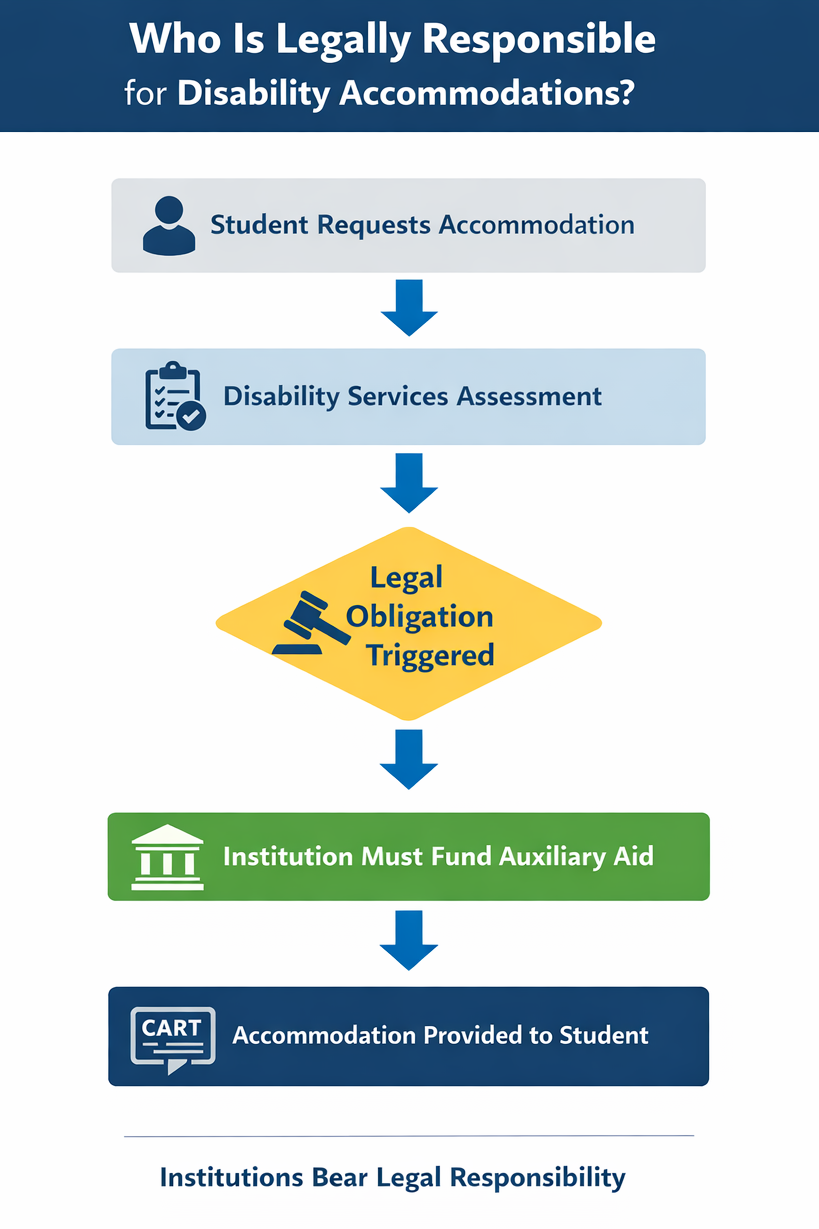
The U.S. Department of Education has repeatedly clarified that institutions cannot charge students for required accommodations.
Definition: Auxiliary Aids and Services
Under the ADA, auxiliary aids include qualified interpreters, note takers, and real time captioning services such as CART.
The Emergence of Cost Shifting
Despite clear statutory language, cost shifting occurs in less visible ways.
Common Cost Shifting Mechanisms
- Requiring students to apply for external disability grants to fund accommodations.
- Delaying services until funding is approved.
- Limiting hours of CART captioning services based on budget rather than academic need.
- Encouraging use of automated captioning instead of human services to reduce institutional expense.
- Informally pressuring students to self fund accommodations for graduate or professional programs.
While institutions may argue these approaches are budget driven rather than discriminatory, the effect is financial displacement from institutional budgets to individual students.
Disability Accommodation in Higher Education: Funding Structures
Most universities fund disability services through central operating budgets. However, budgetary pressures have intensified:
- Rising enrolment without proportional funding increases.
- Expanding digital infrastructure costs.
- Growing numbers of students disclosing disabilities.
In the United States, the National Center for Education Statistics reports that approximately 21 percent of undergraduates report a disability. Canadian surveys show similar trends, with learning disabilities and mental health conditions increasingly represented.
As demand rises, institutions face increased accommodation expenditures. Instead of expanding central budgets, some institutions attempt to offset costs through:
- External bursaries.
- Government disability grants.
- Limited service caps.
This approach reframes accommodation as an individual expense rather than a systemic responsibility.
Ethical and Legal Implications of Cost Shifting
Legal Risk
Under both Canadian and U.S. frameworks, charging students directly for accommodations that are necessary for equal access creates compliance risk.
Courts have consistently held that:
- Institutions bear primary responsibility.
- Budget constraints are not sufficient justification unless undue hardship is demonstrable.
- Equal access must be effective, not merely symbolic.
Failure to provide real time captioning for universities when required has resulted in federal investigations and consent decrees in the United States.
Ethical Considerations
Cost shifting creates unequal academic conditions:
- Students without disabilities pay tuition that includes full access.
- Students with disabilities face additional administrative burdens.
- Financial stress may discourage accommodation requests.
Peer reviewed research in disability studies has shown that administrative barriers reduce accommodation uptake and academic persistence. When services depend on external funding approval, delays can directly impact grades and retention.
Economic Consequences
Short term savings may lead to long term costs:
- Increased attrition among students with disabilities.
- Human rights complaints.
- Reputational harm.
- Litigation expenses.
Institutions that view accessibility as risk management rather than compliance often underestimate cumulative legal exposure.
Certainty level: 88 percent based on existing case law trends and regulatory guidance.
Why CART Captioning Is a Compliance Essential, Not a Luxury
CART captioning services provide real time, human generated transcription of spoken content in classrooms, seminars, and events.
Definition: CART Captioning Services
Communication Access Realtime Translation involves a trained professional producing verbatim text in real time, typically displayed on a laptop, tablet, or projection screen.
CART differs from automated speech recognition in key ways:
- Human accuracy and contextual correction.
- Adaptation to discipline specific terminology.
- Immediate clarification of unclear speech.
- Compliance with effective communication standards.
Under ADA compliance colleges and Canadian human rights law, communication must be effective. If automated systems produce significant error rates, particularly for technical lectures, they may fail to meet this standard.
Research published in academic accessibility journals indicates that automated captioning error rates can range from 10 percent to over 30 percent depending on audio quality and accents. In contrast, professional CART captioners often achieve accuracy above 98 percent in controlled environments.
If a student cannot fully access lecture content, compliance is not satisfied.
Therefore, real time captioning for universities should be funded as a core academic service, similar to library access or learning management systems.
Institutional Accountability and Governance
Accessibility governance varies by institution:
- Some centralize disability services within academic affairs.
- Others place responsibility within student services.
- Budget authority may be fragmented across faculties.
Fragmentation increases the risk of cost shifting. When individual departments must absorb accommodation costs, financial incentives may discourage compliance.
Best practice models include:
- Centralized funding pools for disability accommodation.
- Clear institutional policies stating that students are not financially responsible.
- Transparent reporting of accommodation expenditures.
- Periodic legal audits of compliance practices.
Institutions that integrate accessibility into strategic planning show stronger compliance outcomes.
FAQ: Post Secondary Accessibility Compliance
What does post secondary accessibility compliance legally require?
It requires institutions to provide equal access to educational programs, including auxiliary aids such as CART captioning services, unless doing so causes undue hardship.
Can colleges charge students for disability accommodation in higher education?
In general, no. Under ADA compliance colleges and Canadian human rights law, institutions cannot require students to pay for accommodations that are necessary for equal access.
Is automated captioning sufficient for compliance?
It depends on effectiveness. If automated systems produce errors that impede comprehension, institutions may fail to meet effective communication standards.
Who is responsible for funding real time captioning for universities?
The institution is responsible. External grants may supplement funding but do not replace institutional duty.
What constitutes undue hardship?
Undue hardship refers to excessive cost or administrative burden that threatens the viability of the institution. Courts set a high threshold for this defense.
Strategic Considerations for Institutions
To maintain compliance and reduce risk, institutions should:
- Conduct internal audits of accommodation funding flows.
- Ensure CART captioning services are budgeted centrally.
- Evaluate automated solutions against accuracy benchmarks.
- Train administrators on accessibility legislation Canada and ADA compliance colleges.
- Treat accessibility as infrastructure rather than discretionary support.
Accessibility compliance is not solely a legal obligation. It is also a measure of institutional governance quality.
Conclusion: Compliance Requires Institutional Responsibility
Post secondary accessibility compliance is grounded in statutory law, human rights principles, and established case law. The legal obligation rests with institutions, not students.
Shifting costs to students with disabilities undermines both compliance and institutional accountability. It increases legal exposure and contradicts established interpretations of disability legislation.
CART captioning services are not supplemental enhancements. They are essential tools for ensuring effective communication and equal academic participation.
Institutions that fund real time captioning for universities as a central compliance obligation position themselves to meet legal standards, reduce risk, and demonstrate responsible governance.