Podcasts are often promoted as flexible, educational, and widely accessible media. In practice, they are primarily audio-first formats. That creates a fundamental barrier for many Deaf and hard of hearing individuals.
Unless a podcast includes high-quality transcripts, captions, or alternative formats, it is not fully accessible. This is not a minor limitation. It is a structural issue rooted in how podcasts are produced and distributed.
This article examines what makes a podcast accessible, where current offerings fall short, and what alternatives provide more reliable access to spoken content.
Why Podcasts Are Often Inaccessible
Podcasts are built around uninterrupted audio. Unlike video platforms, most podcast apps do not natively support captions. This creates three common barriers:
- No captions or synchronized text
- Limited or missing transcripts
- Audio quality that varies widely
Research in media accessibility and disability studies consistently shows that access to spoken information requires multimodal delivery. Studies in journals such as Disability and Rehabilitation: Assistive Technology and reports from Ofcom (UK communications regulator) highlight that captions and transcripts significantly improve comprehension and engagement for Deaf and hard of hearing users.
Without these supports, podcasts rely heavily on residual hearing, which is not sufficient for many listeners.
What Makes a Podcast Accessible
An accessible podcast is not defined by its content alone. It depends on how that content is delivered.
Transcripts vs Captions vs Summaries
- Transcripts
Full text versions of the audio. Useful, but often not time-synced. Quality varies depending on whether they are human-edited or auto-generated. - Captions
Time-synchronized text aligned with speech. Rare in traditional podcast apps but common in video formats. This is the most accessible format for many users. - Summaries
Brief overviews of episodes. Helpful for context but not a substitute for full access.
From an accessibility standpoint, captions are the most effective. Transcripts are the minimum acceptable standard.
Audio Clarity and Structure
Even with transcripts, audio quality matters:
- Multiple speakers without clear identification reduce usability
- Overlapping dialogue makes transcription less reliable
- Poor recording quality increases interpretation errors
Clear speaker labeling and structured dialogue improve both listening and reading access.
Platform Limitations
Most podcast platforms, including Apple Podcasts and Spotify, still treat transcripts as optional features. When transcripts are available, they are often:
- Auto-generated with errors
- Hidden in secondary menus
- Not downloadable or searchable
This limits their practical usefulness.
Examples of Relatively Accessible Podcasts
Some widely known podcasts have taken steps toward accessibility. However, each still has limitations.
TED Talks Daily / TED Radio Hour
Strengths:
- Reliable, human-edited transcripts available on the TED website
- Clear speaker delivery and structured storytelling
Limitations:
- No built-in captions in podcast apps
- Requires switching platforms to access transcripts
The Daily (New York Times)

Strengths:
- Transcripts published for most episodes
- Consistent production quality
Limitations:
- Transcripts are sometimes delayed
- Not integrated directly into listening platforms
Freakonomics Radio
Strengths:
- Full transcripts available on the website
- Clear narration style
Limitations:
- Occasional discrepancies between audio and transcript
- No captioned format
Stuff You Should Know
Strengths:
- Long-form transcripts available
- Predictable conversational structure
Limitations:
- Informal dialogue can reduce transcript clarity
- No synchronized captions
Radiolab
Strengths:
- High editorial standards and detailed transcripts
- Strong narrative structure
Limitations:
- Complex sound design can make transcripts harder to follow
- No caption integration
Deaf and Accessibility-Focused Podcasts
Some podcasts are created with Deaf and hard of hearing audiences in mind. These often offer better contextual relevance but still vary in accessibility execution.
Deaf Gain
Strengths:
- Focus on Deaf culture, identity, and lived experience
- Relevant and community-centered content
Limitations:
- Accessibility depends on episode format and distribution platform
- Not always consistently captioned
That Deaf Guy (related content ecosystem)
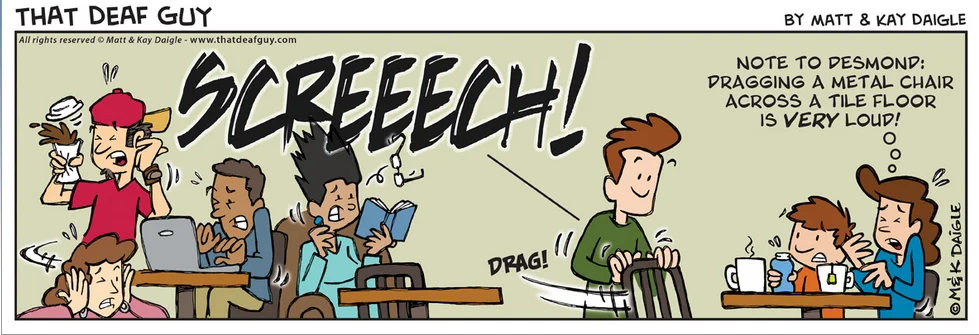
Strengths:
- Cultural insight and humor rooted in Deaf experience
Limitations:
- Content may be fragmented across formats
- Accessibility features vary widely
AMI (Accessible Media Inc.) Content
Strengths:
- Strong institutional commitment to accessibility
- Often includes captions and multiple formats
Limitations:
- Discoverability can be limited outside their ecosystem
Why Most Podcasts Are Still Not Accessible
Despite growing awareness, most podcasts remain inaccessible by default.
There are several reasons:
- Production habits: Audio-only workflows dominate
- Cost concerns: Human transcription and captioning require resources
- Platform gaps: Podcast apps have not prioritized accessibility features
- Lack of standards: No universal requirement for transcripts or captions
Ofcom and other regulatory bodies have noted similar gaps in broadcast accessibility. While television has established captioning standards, podcasting remains largely unregulated.
The result is inconsistent access that depends on individual creators rather than systemic design.
A More Accessible Alternative: Video-Based Podcasts
For many Deaf and hard of hearing users, YouTube-based podcasts offer a more practical solution.
Why Video Podcasts Are More Accessible
- Built-in captioning systems
- Easier integration of human-edited captions
- Visual cues such as facial expressions and speaker changes
While auto-captions are not perfect, they are often easier to access and improve over time.
Examples
Huberman Lab
- Offers YouTube versions with captions
- Structured delivery improves caption accuracy
Lex Fridman Podcast
- Long-form interviews with relatively clear speech patterns
- Captions available on video platform
Diary of a CEO
- Strong production quality
- Captions consistently available on YouTube
These formats are not flawless, but they reduce friction compared to audio-only platforms.
Practical Strategy: How to Evaluate Podcast Accessibility
A practical approach is more effective than relying on labels like “accessible podcast.”
1. Check for Transcripts First
- Look on the official website
- Verify whether transcripts are complete and human-edited
2. Assess Caption Availability
- Search for a YouTube or video version
- Confirm captions are available and readable
3. Evaluate Audio Structure
- Avoid podcasts with overlapping speakers
- Prefer structured interviews or monologues
4. Test Before Committing
- Review a short segment
- Check transcript alignment with audio
5. Avoid Assumptions
Do not assume that a popular or “educational” podcast is accessible. Many are not.
The Role of CART Captioning in Audio Accessibility
Podcasts highlight a broader issue: spoken content is often distributed without real-time access.
CART (Communication Access Realtime Translation) addresses this gap in live settings by providing immediate, accurate captions. In educational, workplace, and event environments, CART ensures that spoken communication is accessible as it happens.
The same principle applies to recorded media:
- Real-time captioning improves comprehension
- Accurate transcription reduces information loss
- Multimodal access supports a wider range of users
Podcasts that integrate professional transcription or captioning move closer to this standard, but most still fall short.
Conclusion
Podcasts are not inherently accessible to hard of hearing individuals. Accessibility depends on additional layers such as transcripts, captions, and structured delivery.
While some podcasts offer partial solutions, gaps remain widespread across platforms and formats. Video-based podcasts with captions currently provide a more reliable alternative.
For users, the most effective strategy is critical evaluation rather than assumption. For organizations, the lesson is broader: accessibility must be built into communication from the start, not added later.
CART captioning represents one model of how real-time communication can be made accessible. Applying similar standards to digital media would significantly improve access to information for Deaf and hard of hearing audiences.