Automated captions, often called automatic speech recognition captions or ASR captions, are increasingly common across education, media, and business. While they offer speed and cost advantages, they also raise serious concerns about accuracy, accessibility, and legal compliance. Understanding when automated captions are appropriate and when human-generated captions are required is critical for institutions seeking both efficiency and inclusion.
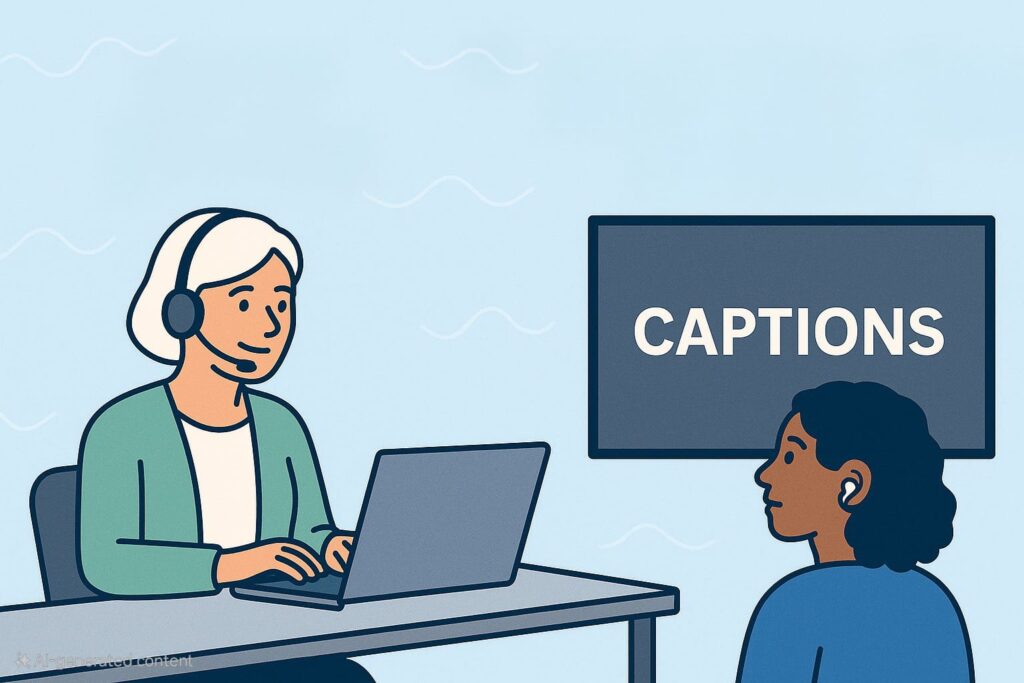
What Are Automated Captions?
Automated captions are generated using speech recognition algorithms that convert spoken language into text in real time or near real time. Popular examples include YouTube automatic captions, Zoom live captions, Microsoft Teams captions, and AI captioning APIs.
Peer-reviewed research consistently shows that automated caption accuracy typically ranges from 60 to 90 percent depending on audio quality, speaker accent, technical vocabulary, and speech rate (Wald, 2020; Shi et al., 2023). This variance is central to determining appropriate use cases.
When Automated Captions Are Appropriate?
Automated captions can be appropriate in low-risk, informal, or non-essential contexts where perfect accuracy is not required.
1. Internal Meetings and Draft Content
For internal team meetings, brainstorming sessions, or rough transcripts intended for internal reference, automated captions can provide functional accessibility and note-taking support.
2. Casual or Non-Critical Video Content
Social media videos, informal webinars, or personal content can often rely on automated captions, provided users understand that errors are likely.
3. Supplementary Accessibility, Not Primary Access
Automated captions may be used as a temporary or secondary accommodation while higher-quality captions are being prepared.
4. Search and Indexing Support
Automated transcripts can help with content indexing, keyword discovery, and internal search, especially when clearly labeled as unedited.
In these cases, automated captions improve access relative to having no captions at all, which is a meaningful benefit supported by accessibility research (Buzzi et al., 2019).
When Automated Captions Are Not Appropriate
There are clear scenarios where automated captions fail to meet accessibility, ethical, or legal standards.
1. Education and Instructional Content
In classrooms, lectures, and training materials, caption errors directly affect comprehension and learning outcomes. Studies show that even small error rates disproportionately harm Deaf and hard-of-hearing students (Kushalnagar et al., 2018). Automated captions are not equivalent to CART or human-edited captions in academic settings.
2. Legal, Medical, and Technical Contexts
Accuracy is non-negotiable in legal proceedings, medical consultations, technical training, and financial disclosures. Automated captions regularly misinterpret specialized terminology, names, and numbers.
3. Compliance With Accessibility Laws
Accessibility regulations such as the Americans with Disabilities Act (ADA), Section 504 and 508 of the Rehabilitation Act, and comparable laws in Canada, the UK, and the EU require “effective communication.” Courts and regulators have repeatedly ruled that inaccurate captions do not meet this standard (National Association of the Deaf v. Harvard, 2019).
4. Live Events With High Stakes
Conferences, public meetings, university classes, and live broadcasts require consistent accuracy, speaker identification, and contextual clarity. Automated captions lack the situational awareness and linguistic judgment of trained human captioners.
Accuracy Is Not a Minor Detail
Caption accuracy is not cosmetic. Word error rates compound rapidly, especially for Deaf users who rely entirely on text. Research indicates that comprehension drops sharply when accuracy falls below approximately 95 percent (Romero-Fresco, 2020). Most automated systems cannot reliably reach this threshold in real-world conditions.
A Practical Decision Framework
Before choosing automated captions, organizations should ask:
- Is this content essential for equal access?
- Would caption errors cause misunderstanding or exclusion?
- Is there legal or institutional compliance risk?
- Are specialized terms, names, or multiple speakers involved?
If the answer to any of these is yes, automated captions are insufficient.
Conclusion
Automated captions are a useful tool, but they are not a universal solution. They work best as a convenience feature or interim aid, not as a substitute for professional captioning in high-impact environments. Treating automated captions as equivalent to human captions undermines accessibility goals and exposes organizations to legal and reputational risk.
Responsible accessibility requires matching the captioning method to the context, not defaulting to automation for cost or speed alone.
References
- Wald, M. (2020). Captioning for Deaf and Hard of Hearing People by Automatic Speech Recognition. Journal of Deaf Studies and Deaf Education.
- Kushalnagar, R. et al. (2018). Accessibility of Educational Materials for Deaf Learners. Educational Researcher.
- Romero-Fresco, P. (2020). Accessible Filmmaking: Integrating Translation and Accessibility into the Production Process. Routledge.
- Buzzi, M. et al. (2019). Making Multimedia Accessible: Captioning and Transcription Practices. Universal Access in the Information Society.
- Shi, Y. et al. (2023). Evaluating Real-Time ASR Caption Accuracy in Educational Settings. ACM Transactions on Accessible Computing.
- National Association of the Deaf v. Harvard University (2019).