By Accurate Realtime Inc.
Understanding the Difference
Many people use the terms captions and subtitles interchangeably — but in accessibility, they serve very different purposes.
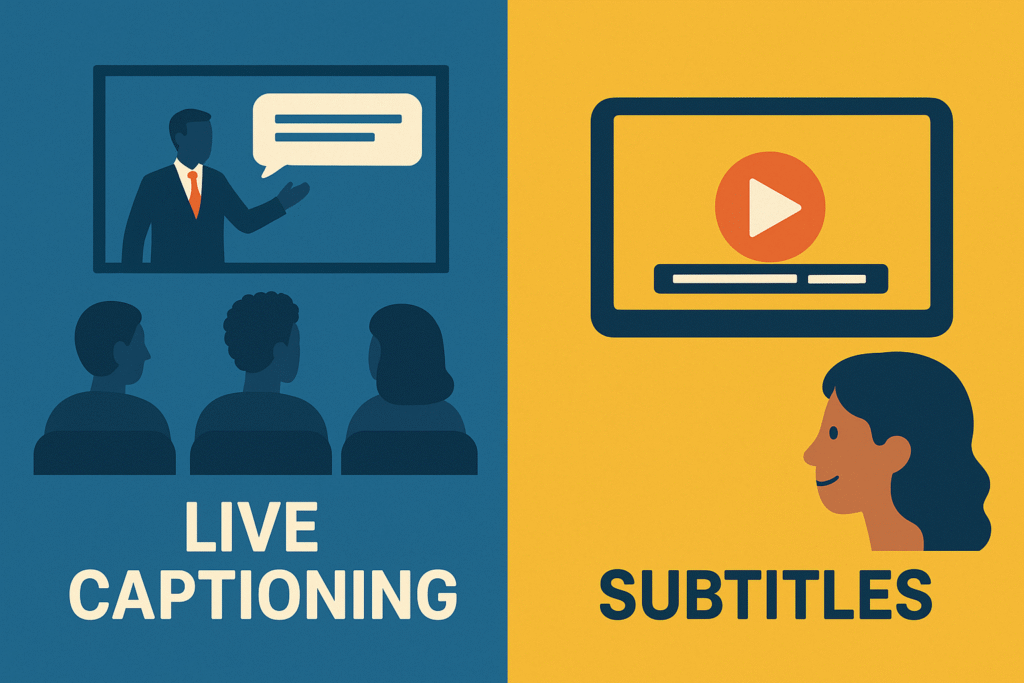
According to the World Wide Web Consortium (W3C, 2019), captions provide a verbatim textual representation of speech and non-speech audio elements such as sound effects or speaker identification. Subtitles, by contrast, are primarily for translation of spoken dialogue into another language and typically do not include these auditory cues.
Live captioning, often called CART (Communication Access Realtime Translation), is the process of converting spoken words into text as they happen — usually performed by a trained captioner. As defined by the National Court Reporters Association (NCRA, 2022), CART provides immediate, word-for-word translation for accessibility in real-time events such as classrooms, webinars, or conferences.
Why Live Captioning Matters
Accessibility laws and standards increasingly recognize the necessity of real-time captioning. The Web Content Accessibility Guidelines (WCAG 2.1), referenced in EN 301 549:2021 and Canada’s Accessible ICT Standard, require organizations to provide live captions for synchronized media and digital communication.
Moreover, Jolly, Macfarlane, and Barker (2024) note in the Journal of Deaf Studies and Deaf Education that Deaf and Hard-of-Hearing (DHH) students experience improved comprehension, engagement, and participation when live captioning is integrated into their learning environments. The study emphasizes that CART captioning “not only supports understanding but also fosters independence and inclusion in academic spaces.”
Human vs. Automated Captions
Automated speech recognition (ASR) systems are improving, but they still fall short in precision. A large-scale analysis by Romero-Fresco and Fresno (2023) found that professional human captioners achieve an average of 99% accuracy, whereas even the best AI-based systems hover between 96–98% under ideal conditions. The researchers highlight that contextual accuracy, speaker differentiation, and idiomatic comprehension remain significant human advantages.
As Millett (2024) points out in The Educator, human captioners outperform automated systems in noisy or multi-speaker environments — common scenarios in education and live events — where audio clarity is variable and technical vocabulary is used.
When to Use CART vs. Subtitles
| Use Case | Recommended Option | Why |
|---|---|---|
| Live lectures, webinars, or meetings | CART (Live Captioning) | Real-time accuracy, includes non-speech cues |
| Recorded videos for multilingual audiences | Subtitles | Translation only, edited for clarity |
| Accessibility compliance (WCAG 2.1) | Captions | Required for inclusive communication |
As per W3C (2019) accessibility guidance, subtitles may meet linguistic needs, but only captions ensure full accessibility by including audio context and speaker identification.
Implementing Effective Live Captioning
To ensure quality CART delivery:
- Use professional captioners. NCRA-certified providers guarantee accuracy and confidentiality.
- Optimize audio sources. Clear microphones and minimal background noise improve speed and readability.
- Integrate with modern platforms. CART integrates seamlessly with Zoom, Microsoft Teams, and StreamText.
- Review for compliance. Meeting WCAG 2.1 standards ensures your organization meets global accessibility requirements.
Conclusion
Live captioning is not just a feature — it’s a commitment to inclusion. Unlike prewritten subtitles, CART brings communication equity to classrooms, boardrooms, and events by ensuring everyone can follow along in real time.
As Romero-Fresco (2023) concludes, the value of live captioning extends beyond accessibility — it’s about “creating shared understanding in real time, where every voice is visible.”
References
- Jolly, A. J., Macfarlane, C. E., & Barker, B. A. (2024). DHH students’ experiences with higher education’s real-time captioning services. Journal of Deaf Studies and Deaf Education.
- Millett, P. (2024). Accuracy of Speech-to-Text Captioning for Students Who are Deaf or Hard of Hearing. The Educator, Association of Educational Audiologists.
- National Court Reporters Association (NCRA). (2022). CART Captioning Best Practices and Standards.
- Romero-Fresco, P., & Fresno, N. (2023). The accuracy of automatic and human live captions in English. Linguistica Antverpiensia.
- World Wide Web Consortium (W3C). (2019). Web Content Accessibility Guidelines (WCAG) 2.1.
- European Telecommunications Standards Institute (ETSI). (2021). EN 301 549 V3.2.1: Accessibility requirements for ICT products and services.