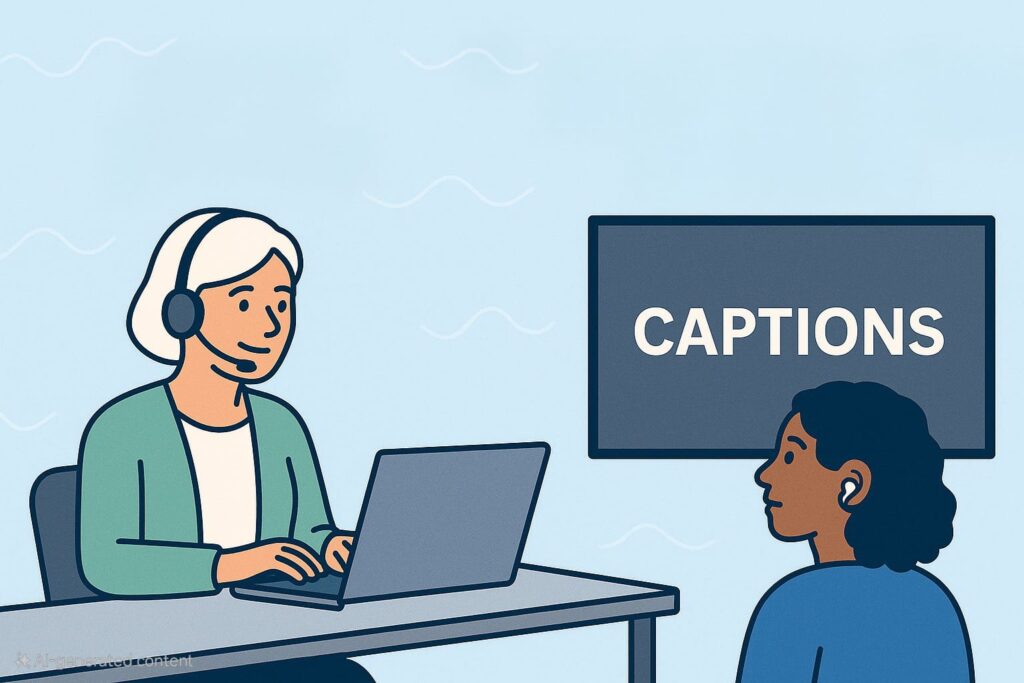
CART (Communication Access Realtime Translation) turns speech into readable text as it’s happening. A trained captioner writes on a steno keyboard (or voice writes), and the text appears on a screen for anyone who needs it—especially people who are deaf or hard of hearing.
From TV captions to in-room CART
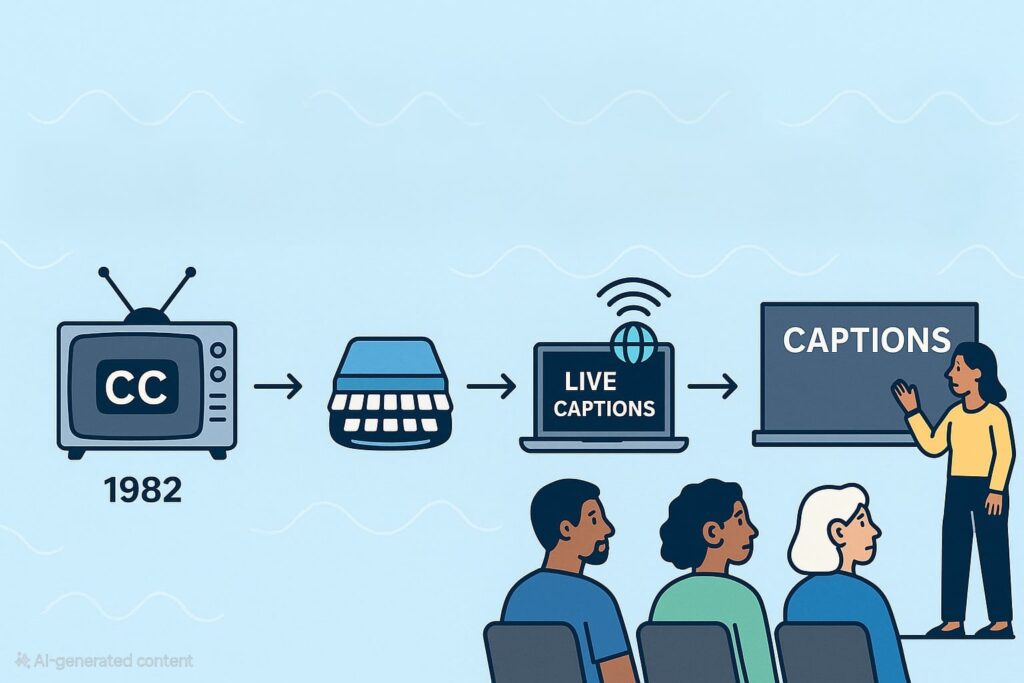
- 1970s–early ’80s: Advocacy and engineering breakthroughs make closed captioning possible on TV; by 1982, live real-time captioning debuts for major broadcasts like the Academy Awards and World News Tonight—powered by court-reporter stenography. These advances showed that real-time text could work outside the courtroom.
- 1980s: Pioneers like Martin “Marty” Block at NCI/WGBH help prove real-time captioning at scale, laying the groundwork for CART use in meetings, classrooms, and events.
- 1990s: The Americans with Disabilities Act (ADA) requires “effective communication” for people with disabilities. CART becomes a recognized auxiliary aid in schools, workplaces, and public events.
- 2000s–today: Remote CART via the internet expands access nationwide and worldwide, so captioners can support classes, webinars, and meetings from anywhere.
Why CART is uniquely helpful
- Immediate understanding: Real-time, verbatim text supports full participation—even with multiple speakers or complex content.
- Works where audio is tough: Noisy rooms, accents, technical vocabulary—CART handles them with prep and custom dictionaries.
- Keeps a record: Many settings provide a session transcript for note-taking and accommodation documentation.
- Complements interpreters: CART can be used alongside ASL interpreting based on the consumer’s preference.
CART vs. auto-captions
Automatic speech recognition has improved, but it still misses names, jargon, and crosstalk and can lag—issues that matter in class, work, and legal contexts. Professional CART is staffed by trained captioners who build terminology and ensure accuracy.
Where you’ll see CART in action
- Education: Lectures, labs, seminars, graduation ceremonies.
- Work: Meetings, trainings, conferences (on-site or remote).
- Civic life: Town halls, court proceedings, community events.
A quick timeline
- 1982: First live real-time TV captions (Academy Awards; World News Tonight).
- 1990: ADA establishes “effective communication” requirements that support CART.
- 2000s: Remote CART becomes mainstream via internet connections.
- Today: CART is standard across classrooms, workplaces, and public events; many organizations publish CART guidance and consumer resources.
How Accurate Realtime supports CART
We provide live, human-powered CART for education, corporate, and legal settings across Canada (and remotely worldwide). We prep your terminology, coordinate access, and deliver on-screen captions with optional transcripts afterwards. (Ask us about semester setups and enterprise accounts.)
Get CART for your next class or event → Contact us