Ensuring accurate communication access is not optional for universities, government agencies, and public institutions. Under federal disability law, real time captioning must provide effective communication, not merely a visible transcript. As institutions evaluate vendors, one question is central: what constitutes an acceptable real time caption error rate?
Understanding live captioning accuracy, industry benchmarks, and legal expectations is critical for ADA captioning compliance and broader accessibility compliance in higher education.
What Is “Error Rate” in Live Captioning?
In live captioning, “error rate” refers to the percentage of words that are inaccurately rendered in real time text compared to the spoken content. Accuracy is typically expressed as a percentage. For example, 98 percent accuracy means that 2 out of every 100 words are incorrect.
However, measuring real time caption error rate is more complex than simply counting typos.
The NER Model: Number, Edition, Recognition
The most widely recognized method for evaluating CART captioning standards is the NER model, developed in the captioning and court reporting industries. NER stands for:
- Number: Total words in the transcript
- Edition: Errors that can be corrected through editing
- Recognition: Errors that cannot be resolved through editing
Under the NER framework, errors are weighted according to severity. Minor punctuation issues may be treated differently than word substitutions that change meaning. The NER model has been referenced in industry research and by organizations such as the National Court Reporters Association (NCRA) as a structured way to evaluate captioning accuracy.
Peer reviewed research in the field of communication access, including work by Dr. Debra L. Russell and others studying captioning quality in educational environments, has emphasized that not all errors are equal. Substitutions that alter meaning can significantly impair comprehension, particularly in technical academic contexts.
This distinction matters when institutions compare vendors. A simple claim of “99 percent accurate” is insufficient without clarity on how accuracy is calculated.
Industry Benchmarks: 98 to 99 Percent Live Captioning Accuracy
Professional CART providers commonly cite accuracy benchmarks between 98 percent and 99 percent for experienced realtime captioners. Within the court reporting profession, 98.5 percent accuracy has often been considered a minimum performance threshold for high level realtime work.
To understand what this means in practice:
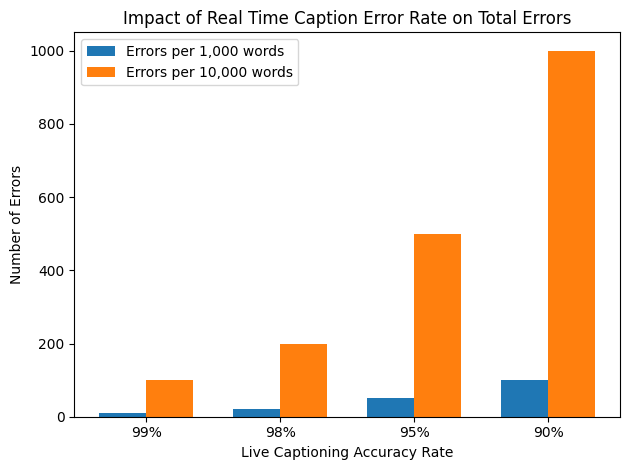
- At 98 percent accuracy, 20 words per 1,000 are incorrect.
- At 95 percent accuracy, 50 words per 1,000 are incorrect.
- At 90 percent accuracy, 100 words per 1,000 are incorrect.
The difference between 98 percent and 95 percent may appear small numerically, but it more than doubles the number of errors. In a 60 minute university lecture containing 9,000 to 12,000 spoken words, this difference can translate into hundreds of additional inaccuracies.
Comparison to Automated Speech Recognition
Automated speech recognition systems frequently advertise high average accuracy rates under controlled conditions. However, independent evaluations published in journals such as Computer Speech and Language and Speech Communication have shown that ASR performance declines in real world environments with:
- Multiple speakers
- Accents
- Technical terminology
- Cross talk
- Poor audio quality
In higher education settings, error rates for automated systems can exceed 10 percent, and sometimes significantly more, depending on conditions.
For accessibility compliance in higher education, the functional question is not average performance under ideal conditions, but reliability during live instruction, seminars, lab discussions, and public events. Professional CART captioning standards generally exceed the consistency achievable by fully automated systems in complex live environments.
ADA Captioning Compliance and Legal Considerations
Federal disability law does not specify a numeric accuracy percentage. However, it does require effective communication.
ADA and Section 504
Under the Americans with Disabilities Act (ADA) and Section 504 of the Rehabilitation Act, public entities and recipients of federal funding must provide auxiliary aids and services that ensure communication with individuals with disabilities is as effective as communication with others.
If captioning is riddled with errors, omitted terminology, or mistranscriptions that alter meaning, it may fail to meet the “effective communication” standard.
Section 508 and Federal Agencies
Section 508 of the Rehabilitation Act requires federal agencies to ensure electronic and information technology is accessible. While Section 508 standards focus heavily on web and multimedia accessibility, live captioning provided by federal entities must still support meaningful access.
Case Law Scrutinizing Captioning Accuracy
Several enforcement actions and settlements involving universities have addressed captioning quality. Although many cases focus on the absence of captions in online media, regulatory agencies have also examined whether captioning provided was sufficiently accurate to allow equal participation.
In Department of Justice and Department of Education Office for Civil Rights resolutions, institutions have been required to ensure that captioning is accurate and complete. The emphasis is not on technical perfection, but on functional equivalence.
Institutions relying on lower accuracy services face compliance risk if captioning errors prevent Deaf or hard of hearing students from accessing course content in real time.
Functional Impact of Real Time Caption Error Rate in Higher Education
The impact of captioning errors is not theoretical. Research in deaf education and communication access has demonstrated that comprehension decreases as error rates increase.
In post secondary classrooms, errors can have amplified consequences:
- Misrendered technical terminology in STEM courses
- Incorrect legal citations in law lectures
- Altered statistical values in research discussions
- Omitted qualifiers such as “not,” “increase,” or “decrease”
Even a small percentage of errors can disrupt note taking, cognitive processing, and exam preparation.
Unlike hearing students, who can rely on auditory redundancy and contextual repair strategies, Deaf and hard of hearing students using live captions depend on text as their primary channel. When errors accumulate, comprehension gaps widen.
A study published in the Journal of Deaf Studies and Deaf Education has noted that caption quality directly affects academic performance and engagement. Real time caption error rate is therefore not merely a technical metric but an educational equity issue.
Ethical Considerations in CART Captioning Standards
Beyond legal compliance, there is an ethical dimension. Accessibility services are intended to level the playing field. Tolerating higher error rates for students with disabilities raises concerns about differential standards.
If institutions would not accept lecture transcripts with frequent inaccuracies for hearing students, it is difficult to justify providing lower fidelity communication to Deaf students.
There is also a transparency issue. Vendors may market “AI powered captioning” without clearly disclosing expected real time caption error rate in live academic settings. Institutions have an ethical obligation to scrutinize claims and demand measurable performance standards.
Setting clear expectations for CART captioning standards reflects a commitment to academic integrity and equal opportunity.
Practical Guidance: Evaluating Live Captioning Accuracy
When assessing vendors for live captioning services, institutions should move beyond marketing claims and request documented metrics.
Questions to Ask Captioning Providers
- How is live captioning accuracy measured?
Is the NER model or another recognized framework used? - What minimum accuracy percentage is contractually guaranteed?
Is this based on independent evaluation? - How are errors audited and documented?
Are transcripts periodically reviewed for quality assurance? - What training and credentials do captioners hold?
Certifications such as Registered Professional Reporter or Certified Realtime Captioner can indicate advanced skill levels. - How is specialized vocabulary handled?
Are course materials provided in advance to support terminology preparation? - What redundancy systems are in place?
For example, backup captioners or technical failover processes.
Establishing Institutional Benchmarks
Institutions should consider defining internal standards for acceptable real time caption error rate. While 98 to 99 percent accuracy is widely recognized as a professional benchmark, the key requirement is that captioning provide effective, reliable communication in academic contexts.
Contracts should include:
- Clear definitions of accuracy
- Quality control processes
- Procedures for addressing performance concerns
- Documentation aligned with ADA captioning compliance
Proactive oversight reduces compliance risk and demonstrates good faith efforts to uphold accessibility compliance in higher education.
Balancing Innovation and Accountability
Emerging technologies offer potential efficiencies, but institutions must distinguish between experimental tools and legally sufficient accommodations.
Automated systems may be appropriate for informal meetings or supplementary transcripts. However, when captioning is a disability accommodation, higher standards apply.
The core question remains practical: does the service enable the student or participant to access information in real time, with accuracy comparable to that experienced by hearing peers?
Error rates that appear statistically minor can produce meaningful educational barriers when compounded over semesters.
Conclusion: Evaluate Captioning Accuracy Before Selecting a Provider
Live captioning accuracy is not a cosmetic metric. It is central to ADA captioning compliance, educational equity, and institutional risk management.
Professional CART captioning standards typically target 98 to 99 percent accuracy under the NER evaluation model. Lower real time caption error rates are directly associated with improved comprehension and reduced compliance exposure.
Before selecting a vendor, institutions should require transparent accuracy metrics, documented quality control processes, and clear alignment with federal accessibility obligations.
Careful evaluation at the procurement stage helps ensure that captioning services fulfill their intended purpose: delivering effective, equitable access to communication in higher education and public institutions.