Workforce inclusion for Deaf professionals has become more complex in the shift toward remote and hybrid work. While virtual environments are often described as flexible and democratizing, research and workplace data suggest they can also intensify communication barriers that affect advancement, leadership visibility, and long term career progression.
For HR directors, DEI leaders, compliance officers, and institutional decision makers, the issue is not limited to accommodation at the hiring stage. It extends to promotion equity, leadership access, and systemic workplace design.
This article analyzes promotion barriers facing Deaf and hard of hearing employees in remote environments, reviews relevant research, outlines legal obligations, and provides practical guidance for improving advancement equity.
The Structural Nature of Promotion Barriers for Deaf Employees
Promotion decisions rarely depend solely on performance metrics. They often involve subjective assessments of leadership presence, communication style, participation in meetings, informal influence, and perceived engagement.
For Deaf professionals, these factors intersect with communication access.
Research in disability employment studies indicates that employees with disabilities are underrepresented in managerial and executive roles compared to nondisabled peers. The U.S. Bureau of Labor Statistics consistently reports lower labor force participation and higher underemployment among individuals with hearing loss. Academic literature in organizational psychology has also documented bias linked to communication differences and assumptions about leadership capability.
In remote work settings, these disparities may widen.
Remote Work Accessibility and Visibility Gaps
Inaccessible Virtual Meetings
Virtual meetings are now central to promotion pathways. Strategy discussions, executive briefings, client presentations, and performance reviews increasingly occur in Zoom or Microsoft Teams.
When accessible virtual meetings are not properly structured, Deaf professionals may experience:
- Delayed or inaccurate automated captions
- Difficulty following rapid speaker changes
- Reduced ability to interject or contribute
- Cognitive overload from correcting caption errors in real time
Automated speech recognition systems vary in accuracy. Peer reviewed studies in speech technology show word error rates ranging from 5 percent in optimal conditions to over 30 percent in real world, multi speaker environments, especially with accents or technical terminology. In high stakes corporate discussions, even minor inaccuracies can distort meaning or undermine credibility.
If a Deaf employee misses nuance in leadership discussions or cannot respond quickly due to caption lag, their perceived engagement may suffer. Over time, this can influence promotion decisions.
Informal Communication Channels
Promotion often depends on informal access:
- Side conversations before or after meetings
- Chat threads with partial context
- Voice based brainstorming sessions
- Impromptu calls
Remote environments shift these interactions into private audio calls or rapid Slack exchanges. Without structured accessibility, Deaf professionals may be excluded from information flows that influence decision making and project visibility.
Workplace sociology research shows that informal networks significantly affect advancement opportunities. When access to those networks is unequal, career stagnation becomes structural rather than individual.
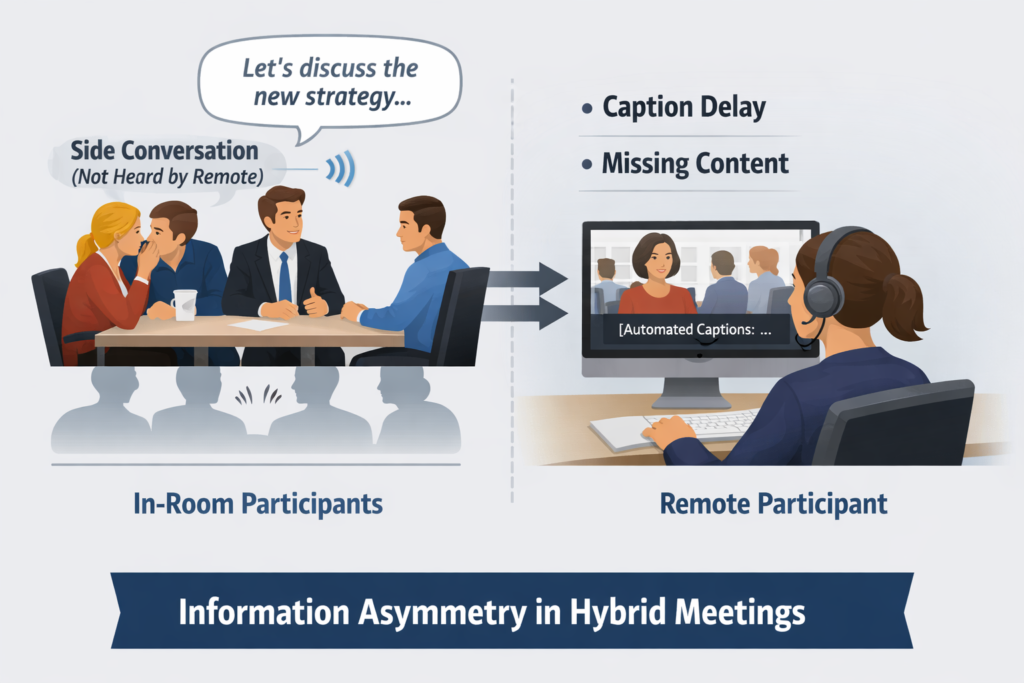
Promotion Barriers Deaf Employees Face in Hybrid Work
Hybrid workplaces introduce additional challenges:
- In room participants converse while remote participants rely on audio feeds
- Microphones fail to capture side discussions
- Camera angles obscure interpreters or caption windows
- Leadership forgets to enable caption feeds consistently
Deaf employees who attend remotely may receive incomplete information compared to in person colleagues. Conversely, if they attend in person without proper CART captioning for corporate meetings, they may struggle to follow group discussion dynamics.
Repeated partial access leads to cumulative disadvantage.
Promotion barriers for Deaf employees often result not from overt discrimination, but from accumulated micro exclusions embedded in workplace design.
Bias, Communication, and Leadership Perception
Organizational behavior research highlights the role of implicit bias in promotion decisions. Leaders may unconsciously equate rapid verbal fluency with competence or leadership readiness.
Studies in disability studies and management journals indicate that employees who communicate differently are sometimes perceived as less assertive or less strategic, regardless of objective performance.
In remote settings, where communication is mediated by technology, these biases may intensify:
- Slight delays due to caption processing may be interpreted as hesitation
- Requests for clarification may be misread as lack of understanding
- Camera based communication constraints may affect perceived presence
Without structural safeguards, these perception biases affect advancement outcomes.
Legal Framework: Equal Opportunity and Advancement
Workforce inclusion for Deaf professionals is not only an ethical objective. It is a legal requirement.
United States
Under the Americans with Disabilities Act, Title I requires employers to provide reasonable accommodations that enable qualified employees to perform essential job functions and access equal employment opportunities. Courts have interpreted equal opportunity to include advancement, not merely initial employment.
Section 504 of the Rehabilitation Act applies to federally funded entities and similarly prohibits discrimination in employment practices.
Canada
Under the Accessibility for Ontarians with Disabilities Act and provincial human rights codes, employers must provide accommodation up to the point of undue hardship. This includes access to meetings, training, and advancement pathways.
Failure to ensure accessible virtual meetings or reliance on inaccurate automated captions in high stakes decision making contexts can expose institutions to compliance risk.
ADA workplace compliance increasingly intersects with remote work accessibility. Courts have recognized virtual environments as extensions of the workplace.
Limitations of Automated Captioning in Professional Settings
Automated captions may be useful for casual content consumption. However, their limitations are well documented:
- Reduced accuracy in multi speaker discussions
- Difficulty with technical vocabulary
- Inability to correct context specific misunderstandings
- No accountability mechanism for error correction
In promotion relevant settings such as board meetings, performance reviews, or strategic planning sessions, these limitations carry professional risk.
A single miscaptioned financial figure, policy term, or performance metric can affect perception.
Professional CART captioning for corporate meetings provides:
- Human edited, context aware real time text
- Immediate correction of errors
- Adaptation to specialized terminology
- Confidential handling under formal agreements
From a risk management perspective, the difference is material.
Practical Recommendations for HR and Leadership Teams
1. Conduct Accessibility Audits of Promotion Pathways
Review how leadership opportunities are communicated and evaluated:
- Are executive meetings fully accessible?
- Are training sessions captioned in real time?
- Are mentorship discussions accessible?
Promotion equity depends on structural access.
2. Standardize CART Captioning for High Stakes Meetings
Establish a policy that strategic meetings, performance reviews, board sessions, and promotion panels include professional CART captioning for corporate meetings when required.
This removes reliance on inconsistent automated systems.
3. Train Managers on Bias and Communication Equity
Leadership training should address:
- Communication style bias
- Turn taking facilitation in virtual meetings
- Ensuring equal participation opportunities
Structured moderation reduces inequity.
4. Integrate Accessibility into IT Infrastructure
IT teams should:
- Enable third party caption feeds in Zoom and Teams
- Configure pinned caption windows
- Ensure camera framing accommodates interpreters and captions
- Document accessibility procedures
Remote work accessibility must be embedded, not reactive.
5. Track Advancement Data
Monitor promotion rates for Deaf and hard of hearing employees relative to organizational averages. Data transparency supports accountability.
CART Captioning as a Scalable Inclusion Strategy
Workforce inclusion for Deaf professionals cannot stop at accommodation for entry level tasks. Advancement requires full participation in strategic conversations.
Professional CART captioning services support:
- Equal access to executive dialogue
- Accurate participation in performance reviews
- Leadership visibility in high profile presentations
- Reduced legal exposure for employers
When implemented systematically, CART captioning becomes part of an inclusion infrastructure that supports talent retention and leadership development.
Institutions that treat accessibility as an advancement issue rather than a compliance checkbox are more likely to retain skilled professionals and reduce litigation risk.
Frequently Asked Questions
What are common promotion barriers for Deaf employees in remote work?
Common barriers include inaccessible virtual meetings, inaccurate automated captions, exclusion from informal communication networks, and bias related to communication style.
Does ADA workplace compliance include promotion opportunities?
Yes. The ADA requires equal access to employment opportunities, including advancement and professional development.
Are automated captions sufficient for corporate meetings?
Automated captions vary in accuracy and may not be appropriate for high stakes professional discussions involving strategy, finance, or personnel decisions.
How can organizations improve workforce inclusion for Deaf professionals?
Organizations can standardize professional CART captioning, train managers on bias, audit promotion processes, and embed accessibility into remote work systems.
Conclusion
Remote and hybrid work environments have changed the structure of workplace interaction. Without deliberate design, they can reproduce or intensify promotion barriers for Deaf employees.
Workforce inclusion for Deaf professionals requires more than hiring equity. It requires accessible virtual meetings, structured communication practices, and reliable CART captioning for corporate meetings that support advancement pathways.
For HR leaders and compliance officers, the question is not whether accessibility is required. It is whether current systems genuinely enable leadership participation.
Organizations that address promotion barriers proactively strengthen compliance, reduce legal exposure, and retain high performing talent in an increasingly digital workplace.